Features
Part of Road trip costs: four-column budget framework
How seasons shape access on a slow road trip
How the seasons open and close access on a slow road trip, from fee-free days and camp-host seasons to shoulder-week trade-offs and mountain road closures.
What to take away
- Fee waivers exist on specific dates, and they cover day use rather than camping.
- A campground with a host has a season, and outside it the facilities may not be maintained.
- Shoulder weeks cut lodging cost and increase weather risk. That is the whole trade.
- The cheapest date is worthless if the road you wanted is closed on it.
On a slow road trip, season sets much of what you can reach and how freely you can move.
A road trip costs time as well as money, and season moves both. Season changes a road trip budget in three places: what you pay to get in, what you pay to sleep, and how far you have to drive because something is shut. Only the first is published as a calendar. The other two need reading route by route.
Fee waivers are dates, not seasons
Some access costs disappear on set days. The standard fee free days are shared across the federal land agencies — the National Park Service, the Bureau of Land Management, the U.S. Forest Service, the U.S. Fish and Wildlife Service and the Army Corps of Engineers. The BLM publishes a list of fee free days and is specific about the limits. For 2026 the list includes Presidents Day in February, Memorial Day in May, the Independence Day weekend in early July, Constitution Day in September and Veterans Day in November, among others.
2026 Fee Free Days
- FebruaryPresidents Day
- MayMemorial Day
- Early JulyIndependence Day weekend
- SeptemberConstitution Day
- NovemberVeterans Day
The waiver applies to standard amenity and day use fees, including visitor centers and picnic areas. Expanded amenity fees stay in place, which means developed camping, cabin rentals and group day use still cost money.
The same BLM page notes that from 2026 free access on those days applies to United States citizens and residents, with nonresidents paying the regular fee. Read the current year's list rather than assuming last year's dates. The America the Beautiful annual pass is the other lever: it covers standard amenity entrance fees at federal sites for a year, so a trip built around several fee free days is worth pricing against the pass.
Those dates are also busy. A fee free day at a popular site trades a few dollars for a full parking lot, which on a slow road trip is a poor exchange.
Camp host months set the real season
A campground page will often tell you when it is properly staffed, and that is a better cost signal than the opening dates. The BLM's page for Chukar Park Campground in Oregon describes a primitive riverside site with 19 campsites, open year round with a camp host present generally from late April through November.
All sites are first come first served with no reservations, potable water available but no showers, no hookups or dump station, and no phone coverage in the campground itself. That makes for a straightforward stay in season and a self-reliant one outside it. If you travel in December, assume the water may be off and carry your own.
Where a campground does take reservations, the federal ones run through Recreation.gov, while state park systems keep their own booking sites. Either way the booking window follows the season, not the map.
The shoulder season trade
- Lodging is easier to book in the weeks either side of the busy months.
- Campgrounds are emptier, and first come sites stop being a gamble.
- Roads are more likely to be wet, muddy or closed.
- Services in small towns run reduced hours, so fuel planning matters more.
Take the shoulder weeks only if the route tolerates them. On paved corridors it usually does. On graded gravel in a wet spring, it often does not.
Roads with a season of their own
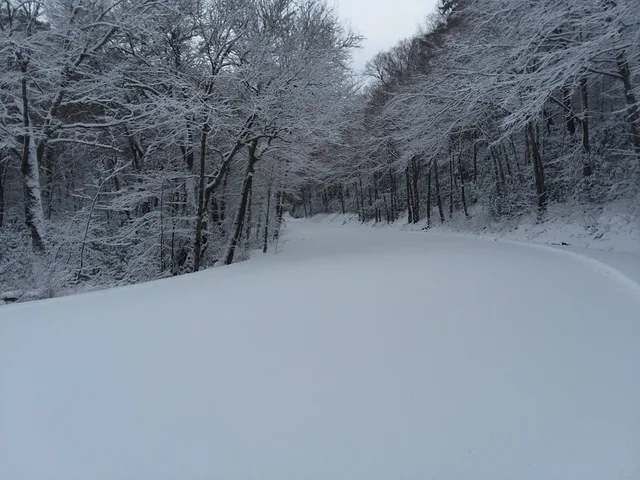
The time cost of a season is easiest to see on the roads that close. Going-to-the-Sun Road in Glacier National Park shuts down for the winter, and so do Trail Ridge Road in Rocky Mountain National Park and the Tioga Pass road into Yosemite. Sections of the Blue Ridge Parkway close on the same pattern, for ice and snow at elevation.
A closed road means a detour or a trip moved to another month, and no fee page warns you about either. The park road status pages publish the openings and closings, so check the one for the park on your route before you commit to a cheap week.
A simple ordering rule
Pick the road first, find its usable window, then plan your trip inside that window. Doing it the other way round produces a frustrating date and a closed gate.
Where to go next
The framework these costs slot into, including a contingency with a defined purpose, is in the road trip budgeting guide. What you carry changes what you spend on the road, which is covered in packing for a budget led trip.