Guides
Part of Fourteen kinds of road trip operator: sorted by what the rules require
Road trip operator questions: permits, group size, and turnaround rules
The questions that separate a real road trip operator from a website in 2027: permits, group size, equipment, turnaround rules and what the price includes.
What to take away
- Some activities require a permit for you as well as for the operator. Ask which applies.
- Group size, equipment and access rules are often set by the resource, not by the company.
- Get the inclusions written down, including fuel, food, entry fees and recovery.
- The turnaround question is the most important one on this page.
Booking a guided day is mostly a matter of asking questions the operator has answered many times before. If any of them produce hesitation, that is the information you came for.
Permits: theirs, and sometimes yours
A trip entering a controlled resource may need separate permission. The BLM's caves and karst program overview explains what it does and provides recreational and primitive caving opportunities.
It manages cave resources under the Federal Cave Resources Protection Act of 1988. The agency manages several thousand caves, mostly in limestone regions, and some caves for public exploration may require a permit.
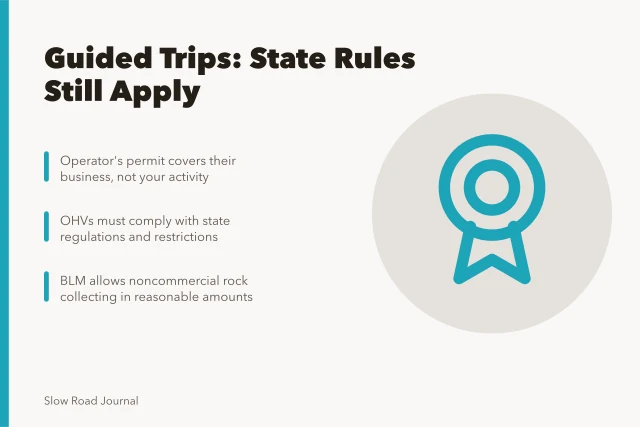
Ask directly: does this trip need a permit in my name, who obtains it, and what happens if it is not granted. The same question applies to river permits, lottery areas and some canyons. A guided day rarely covers state vehicle rules or collecting limits, and the permit is not a promise.
Ask what the route actually is
Operators sometimes describe a region when they mean a specific road. Regional byway listings are a good way to check what they are actually offering. The BLM's page on byways in Utah lists the state's back country routes with descriptions.
One is the Bull Creek Pass Back Country Byway. It is a 68 mile route through the Henry Mountains between Capitol Reef and Canyonlands National Parks. It climbs nearly a mile as it loops through the range, on a road built to provide access to the Henry Mountains.
Read the route page, then ask the operator which sections of it you will actually drive. A 68 mile byway and a two hour sample of it are different products. A two-day itinerary built around one operator shows how much of a byway fits into a guided day.
The questions, in order
- Which office issued your permit for this area, and what does it cover?
- Do I need a permit of my own, and who applies for it?
- What is the group size, and what is the guide to client ratio?
- What vehicle and recovery equipment do you carry?
- What conditions make you turn back, and who decides?
- What is included: fuel, food, water, entry fees, recovery?
- What is the cancelation policy for weather and for road closures?
- When were you last on this specific route?
Reading the answers
| Answer | What it tells you |
|---|---|
| Names the office and the permit type | Established, accountable operator |
| Cannot say who obtains your permit | Expect a problem on the day |
| No stated turnaround rule | Judgment under pressure, which is worse |
| Written inclusions list | Has been asked before and learned |
| Detailed weather policy | Has canceled trips, which is a good sign |
Where to go next
To work out which type of operator you should be calling at all, see the fourteen kinds of road trip operator. The equivalent questions for a self drive route are in questions to ask when booking scenic drives.
Common questions
Is a deposit normal? Yes, for small operators with limited dates. Ask for the cancelation terms in the same message.
How large is too large a group? On back roads, anything that needs more than two vehicles slows to the pace of the slowest. Small groups see more.
Should I book directly or through a platform? Directly where you can. You get the person who will actually be driving, and better answers.
What if the operator says the route is never closed? Treat that as a warning. Every back country route closes sometimes, and an operator who says otherwise is not describing the road.